


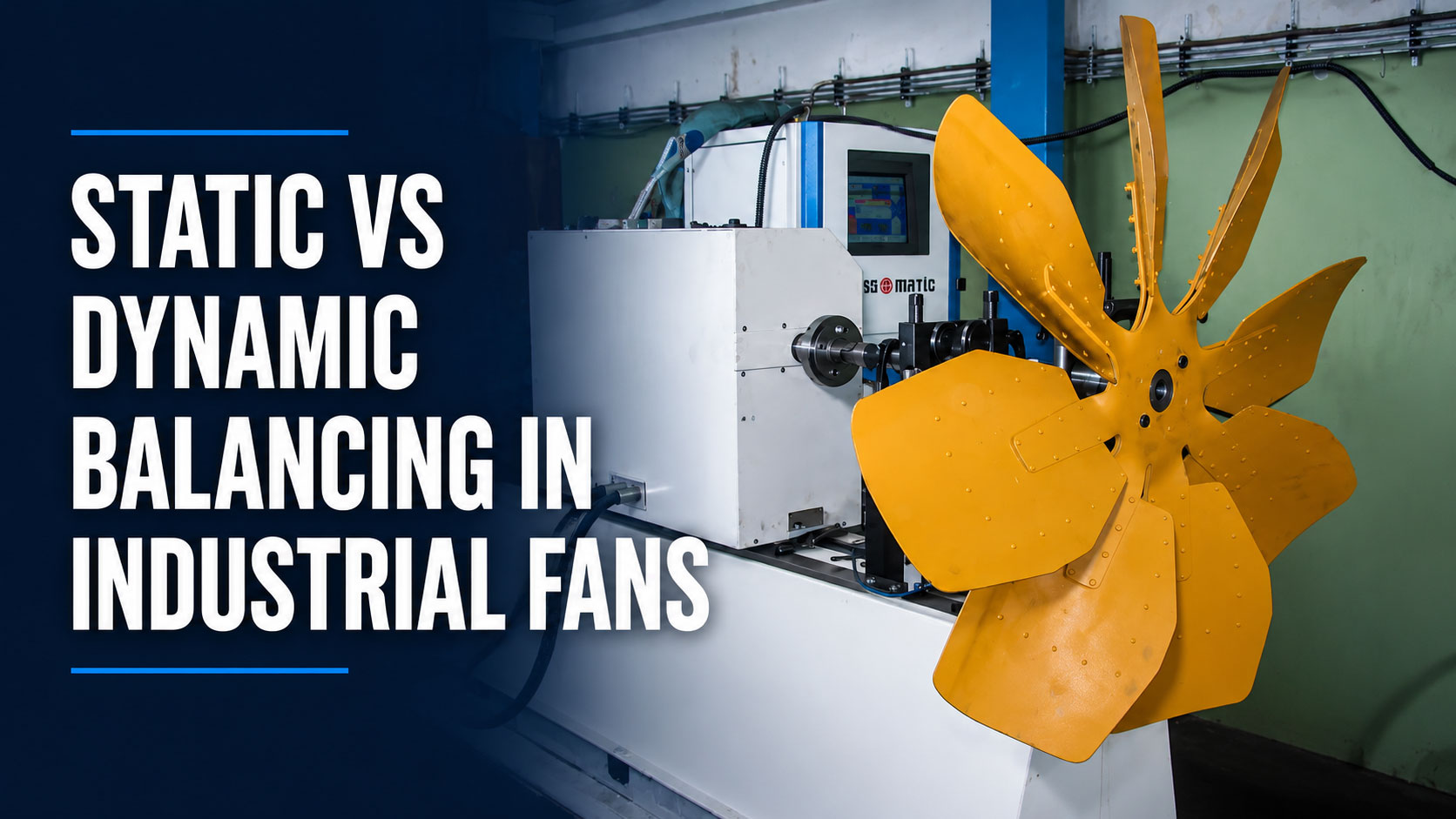
Balance quality in industrial fans directly affects vibration level, noise, bearing life, energy efficiency, and overall equipment reliability. When a fan rotor has unbalance, centrifugal forces are generated during rotation. These forces are transmitted to the bearings, housing, frame, and connected equipment as vibration. For this reason, selecting the correct balancing method is essential in both fan production and maintenance.
Static balancing focuses on correcting unbalance in a single plane. In simple terms, if one side of the rotor is heavier than the other and the unbalance can be corrected in one correction plane, static balancing may be sufficient. This method is generally suitable for narrow, low speed, or single plane fan rotors.
Dynamic balancing considers unbalance in two planes. It is required for wider rotors, high speed fans, long rotor bodies, or components that may generate couple unbalance during operation. In dynamic balancing, the rotor is rotated at a controlled speed and unbalance values are measured in two correction planes. Correction can be performed by adding weights, removing material, applying clip weights, or welding correction weights depending on the fan design.
Whether static balancing is sufficient for an industrial fan depends on several factors: rotor diameter, width, operating speed, mass distribution, bearing arrangement, and application. A narrow, low speed fan may perform acceptably after static balancing, while a high speed axial or radial fan often requires dynamic balancing to achieve reliable vibration performance.
The main advantage of dynamic balancing is that it provides a more complete evaluation of the rotor’s behavior during rotation. Vibration may not be caused only by a single heavy point; it can also result from mass distribution along the width of the rotor. Two plane dynamic balancing corrects this condition more accurately.
For fan manufacturers, the balancing machine must be selected according to the fan type. Axial fans, radial fans, blower wheels, and special impellers may require different clamping systems, adaptors, measuring principles, and correction methods. The ability to balance multiple fan types on the same machine can provide significant flexibility in production.
Messmatic can design balancing solutions for axial and radial fans, including customized clamping systems, static or dynamic balancing configurations, and application specific correction methods.