
Brake discs are safety critical rotating components. Their balance quality has a direct impact on vibration, noise, driving comfort, bearing load, and service life. For this reason, balancing is not only a quality control step in brake disc production; it is an essential part of the manufacturing process. Choosing the right balancing machine is therefore critical for both product quality and production efficiency.
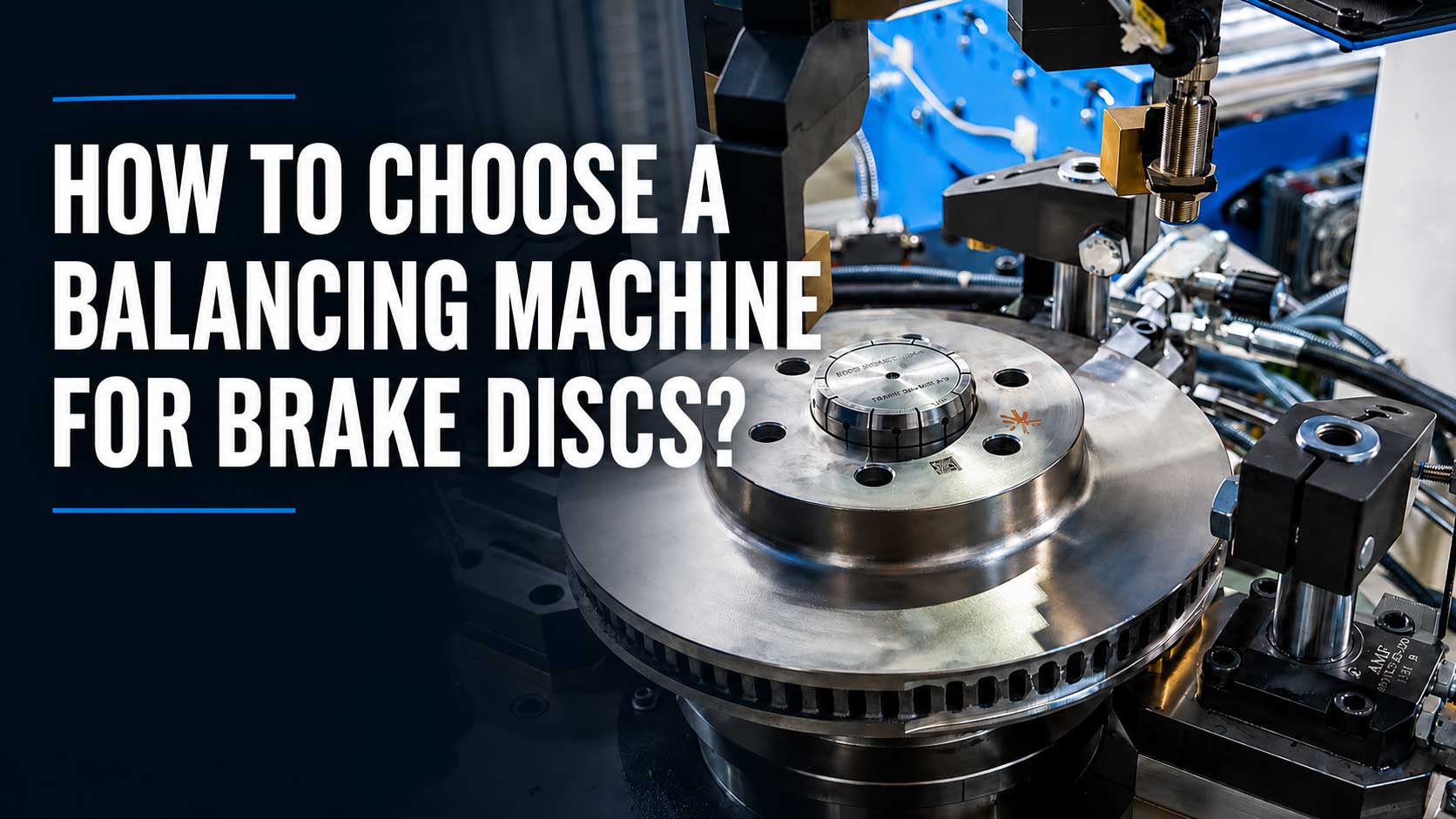
The first factor to consider is the geometry of the brake disc. Outer diameter, height, weight, center hole, mounting surfaces, ventilation structure, and available correction areas must be evaluated carefully. Not every brake disc can be clamped or centered in the same way. The fixture, adaptor, table, or centering system of the machine must be designed according to the specific part geometry.
The second factor is production volume. For low-volume production, prototype work, or maintenance applications, a manual or semi-automatic balancing machine may be sufficient. For serial production, however, automatic loading, measuring, angular positioning, and drilling or milling correction can significantly reduce cycle time and improve repeatability.
The correction method is another key decision. In brake disc balancing, material removal by drilling or milling is commonly used. Drilling can offer a fast correction process, while milling may provide more controlled material removal for certain geometries and surface requirements. The allowed correction area, maximum number of holes, hole depth, tool diameter, and visual requirements of the part should all be considered during machine design.
Balancing tolerance is also important. The required residual unbalance depends on the operating speed, rotor mass, customer specification, and applicable quality requirements. The balancing machine software should allow part recipes to be stored and recalled easily. It should also display the initial unbalance, correction values, residual unbalance, and final OK/NOK result in a clear and traceable format.
Automation requirements must be evaluated at the beginning of the project. In modern brake disc production lines, the balancing machine may need to communicate with robots, conveyors, PLC systems, data matrix readers, marking devices, and factory traceability systems. In this case, the balancing machine becomes a fully integrated production station rather than a standalone piece of equipment.
A well-selected brake disc balancing machine should offer a rigid mechanical structure, accurate measuring system, reliable correction method, safe operating area, user-friendly software, and integration capability for automated production. Messmatic designs brake disc balancing machines according to the customer’s part geometry, tolerance requirement, production volume, and automation strategy.